


Press Release
Nov 6, 2025
From genes to face and skull: HKUMed uncovers key causes of congenital craniofacial abnormalities to improve prenatal detection of cleft lip and skull malformations
Professor Martin Cheung Chi-hang (middle, front row) and the research team used chick embryos, an established model that closely resembles early human embryonic development, to understand the risk factors in cell development.
Press Release (2025-11-06)
Source: From genes to face and skull: HKUMed uncovers key causes of congenital craniofacial abnormalities to improve prenatal detection of cleft lip and skull malformations
A research team from the LKS Faculty of Medicine at the University of Hong Kong (HKUMed) has identified key causes of abnormalities in the head and face of newborns, such as a cleft lip, cleft palate, and underdeveloped facial and skull bones. The study reveals that a specific group of cells in the embryo, known as neural crest cells, are particularly vulnerable to genetic disruptions during early development. These cells play a vital role in shaping the face, skull and parts of the nervous system. The findings help explain how errors in genetic processing can lead to birth defects. This insight could pave the way for advanced prenatal genetic tests and the application of genome-editing tools to correct harmful DNA mutations before birth. The research findings were published in the multidisciplinary science journal Nature Communications [link to the publication].
Genetic mutations can cause craniofacial abnormalities
‘About one-third of babies born with birth defects have abnormalities in the head and face. These structures form early in human embryonic development from neural crest cells, which originate in the developing brain and neural tube before moving, throughout the embryo to help construct the face, skull and peripheral nervous system,’ said Professor Martin Cheung Chi-hang, Associate Professor, Associate Director (Research & Innovation) at the School of Biomedical Sciences, HKUMed.
Genetic mutations disrupt proteins essential for the development of neural crest cells. When these proteins do not function properly, it can lead to birth defects such as facial and skull abnormalities. Some of these faulty proteins serve as splicing factors, which help process genetic information to produce functional proteins. ‘Our research sheds light on how mutations in genes that are active across all cells can lead to highly specific developmental defects in the face and skull. By identifying the causes which explain the unique vulnerabilities of neural crest cells, we are one step closer to understanding—and potentially preventing—these congenital conditions,’ said Professor Cheung.
Chick embryo model reveals risk factors in cell development
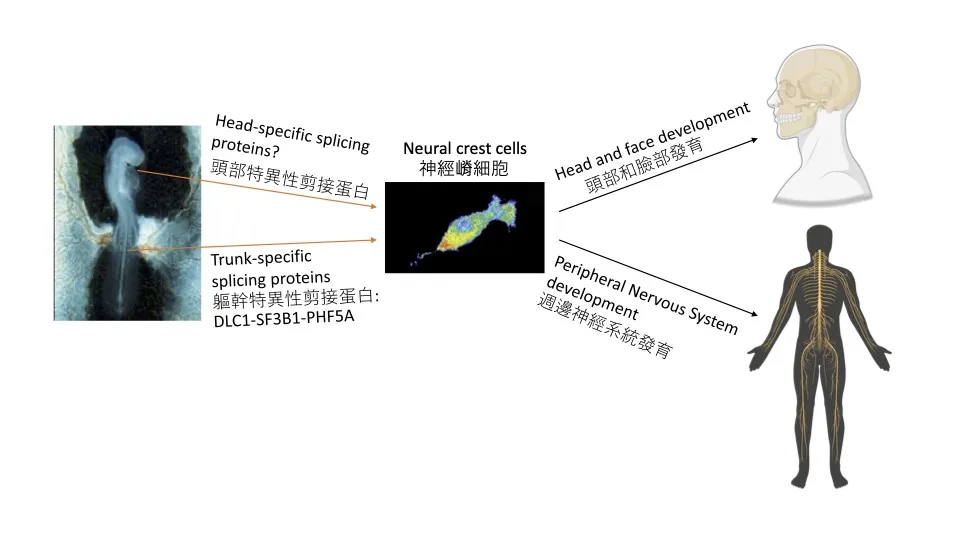
To investigate further, the team used chick embryos, an established model that closely resembles human embryonic development at the early stages. They discovered that three splicing proteins—DLC1, SF3B1 and PHF5A— work together as a complex to support the formation of neural crest cells. A deficiency in any of these proteins disrupts cell formation, leading to abnormal development of the peripheral nervous system. This protein complex also increases the sensitivity of neural crest cells to splicing perturbations.
In contrast, the research team identified another protein complex made up of SLU7, SF3B1 and PHF5A in somites, which are cells that eventually form the vertebrae of the spine and skeletal muscle. These proteins help stabilise somites, making them less susceptible to disruptions in genetic processing. ‘Overall, this study reveals that different cell types rely on different combinations of splicing proteins, and some are more vulnerable to genetic changes than others. This helps explain why certain birth defects occur and could guide future research on prevention and treatment,’ stated Professor Cheung.
Identifying head-specific splicing proteins for future genome editing
‘Our findings suggest that there may be specific splicing proteins in the head that make neural crest cells more sensitive to genetic mutations. Understanding these mechanisms could lead to new genetic markers for prenatal diagnosis,’ added Professor Cheung.
The research team now plans to identify these head-specific splicing proteins. If successful, their discoveries could lead to new genetic tests for prenatal diagnosis. They also hope to use genome editing technologies like CRISPR, to correct harmful DNA mutations before birth, potentially preventing the development of facial and skull abnormalities.
About the research team
The research was led by Professor Martin Cheung Chi-hang, Associate Professor, Associate Director (Research & Innovation) of the School of Biomedical Sciences, HKUMed; and Professor Jessica Liu Aijia, Assistant Professor in the Department of Neuroscience, College of Biomedicine, CityU.
Acknowledgements
The research was supported by the General Research Fund of the Research Grants Council of Hong Kong, China, and Seed Fund for Basic Research, HKU.
Media enquiries
Please contact LKS Faculty of Medicine of The University of Hong Kong by email (medmedia@hku.hk).
New Releases
Oct 8, 2026
Hong Kong’s Biotech Ecosystem Gains Momentum: HKUMed and Skyhore Collaborate to Drive Innovation and Cultivate Future Leaders in Microbiome Science
Sep 17, 2026
HKUMed School of Biomedical Sciences and Phase Scientific join forces to nurture Hong Kong's next-generation biomedical talent through academic-industry collaboration
Jun 8, 2026
