


Seminars
Aug 12, 2026
Protein folding in the cell: The power of basic research to provide fundamental insights into human disease
School of Biomedical Sciences cordially invites you to join the seminar
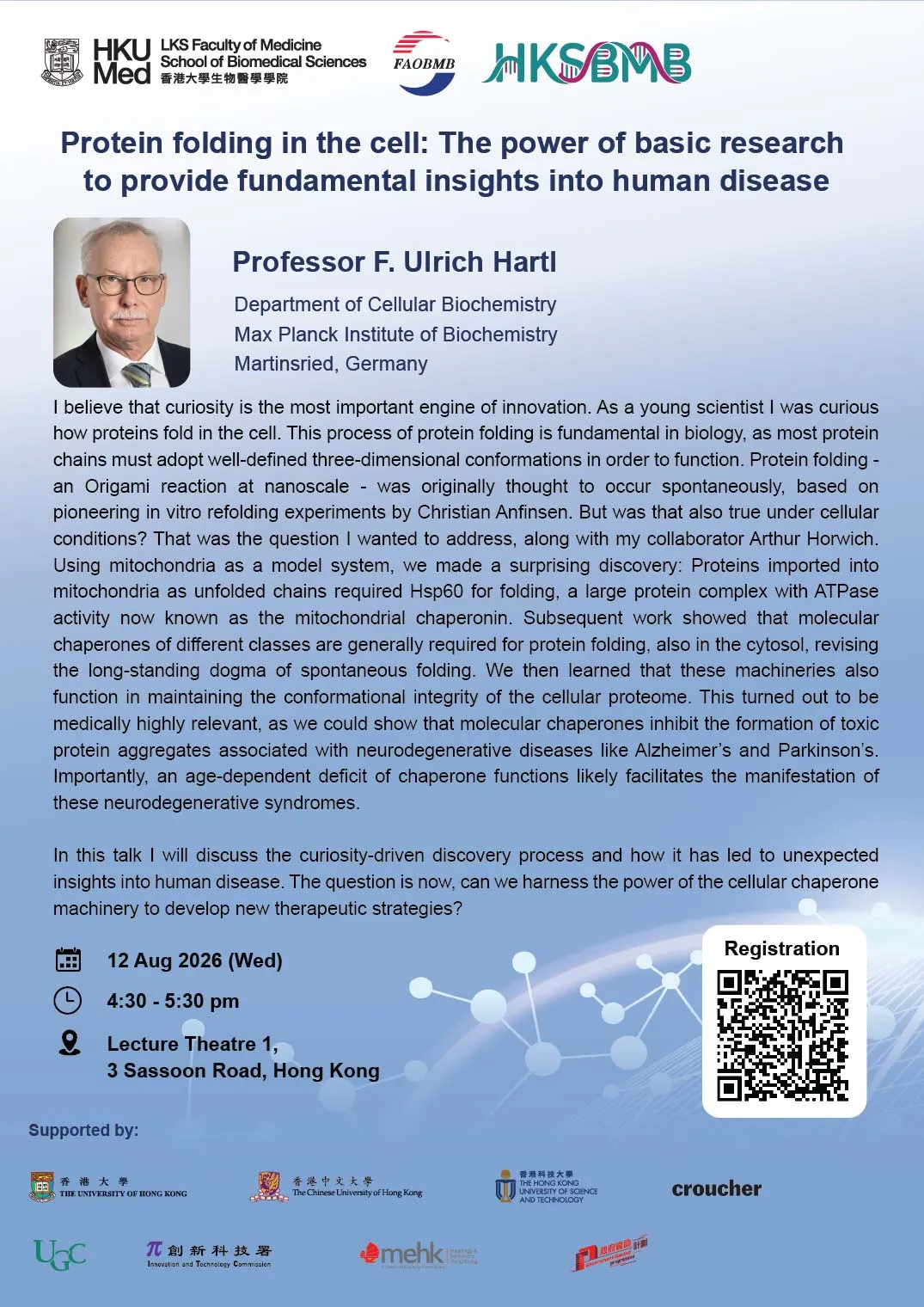
Date: 12 Aug 2026 (Wed)
Time: 4:30 - 5:30 pm
Venue: Lecture Theatre 1, 3 Sassoon Road, Hong Kong
About the speaker
Prof. F.-Ulrich Hartl is a distinguished German biochemist renowned for his groundbreaking discovery of chaperone-mediated protein folding. His work revolutionized cell biology by overturning the long-held assumption that proteins fold spontaneously into their active shapes. His foundational breakthrough occurred in the late 1980s alongside collaborator Arthur Horwich. Together, they identified molecular chaperones as mandatory biological machines that assist newly synthesized proteins. Hartl detailed how chaperones like GroEL/GroES act as physical protective cages, encapsulating individual protein molecules to prevent toxic aggregation.In recent years, Prof. Hartl's research focuses heavily on the direct link between chaperone dysfunction, cellular aging, and neurodegenerative disorders. His laboratory at the Max Planck Institute studies how manipulating these protein-folding networks could halt toxic plaque accumulation in diseases like Alzheimer's, Parkinson's, and Huntington's. A highly cited scientist, Prof. Hartl has received numerous prestigious awards for his medical contributions. He was previously honored with the Albert Lasker Award, the Shaw Prize, and the Breakthrough Prize in Life Sciences. His recent accolades include the 2022 HFSP Nakasone Award, the 2023 Schleiden Medal, and the 2024 BBVA Foundation Frontiers of Knowledge Award. Today, Prof. Hartl continues to actively guide therapeutic research aimed at harnessing chaperone mechanisms to combat age-related neurodegeneration.
Abstract
I believe that curiosity is the most important engine of innovation. As a young scientist I was curious how proteins fold in the cell. This process of protein folding is fundamental in biology, as most protein chains must adopt well-defined three-dimensional conformations in order to function. Protein folding - an Origami reaction at nanoscale - was originally thought to occur spontaneously, based on pioneering in vitro refolding experiments by Christian Anfinsen. But was that also true under cellular conditions? That was the question I wanted to address, along with my collaborator Arthur Horwich. Using mitochondria as a model system, we made a surprising discovery: Proteins imported into mitochondria as unfolded chains required Hsp60 for folding, a large protein complex with ATPase activity now known as the mitochondrial chaperonin. Subsequent work showed that molecular chaperones of different classes are generally required for protein folding, also in the cytosol, revising the long-standing dogma of spontaneous folding. We then learned that these machineries also function in maintaining the conformational integrity of the cellular proteome. This turned out to be medically highly relevant, as we could show that molecular chaperones inhibit the formation of toxic protein aggregates associated with neurodegenerative diseases like Alzheimer’s and Parkinson’s. Importantly, an age-dependent deficit of chaperone functions likely facilitates the manifestation of these neurodegenerative syndromes.
In this talk I will discuss the curiosity-driven discovery process and how it has led to unexpected insights into human disease. The question is now, can we harness the power of the cellular chaperone machinery to develop new therapeutic strategies?
All are welcome.
New Releases
Jun 8, 2026
HKUMed School of Biomedical Sciences and Votee AI sign MoU to launch student internships and joint R&D in applied AI
May 28, 2026
HKUMed develops innovative tool to repair genetic errors, offering new hope for neurodegenerative diseases
Mar 9, 2026
